Cover Letters: Are They Relevant, and Do I Need One?

Updated: Jun 1
Love them or loathe them, cover letters are a standard part of the application process that most job applications will require.
When I have spoken with recruiters at networking events, studios such as Disney and ILM explicitly said that they do read cover letters, and enjoy reading your 'origin' story.
Moreover, for an emerging artist, they help give your skills and current experience context.
The resume is such an economic space that you won't have room to expand on details or provide credible anecdotes that support your application.
The cover letter allows you to tell those stories.
So, rather than see the cover letter as a chore, see it as an opportunity. After all, in a competitive employment market, why wouldn't you give yourself every chance to stand out!
Let's get into it.

What is a Cover Letter?
Give us the good stuff!
Imagine you're a recruiter looking at two or more similar applicants with the same skills and similar demo reels.
One wrote a cover letter with AI.
One didn't bother to write a letter.
And the other read this article, 😉 and put real thought and effort into a letter, engaged the recruiter, and showcased their skills.
Which candidate do you think will get invited for an interview? A well-written cover letter is essential for getting your application over the finish line because they allow you to introduce yourself, showcase your personality, and explain why you're a good fit for the role.
A fantastic article about cover letters written by an ILM Recruiter: Cover Letters – what is the point of them?
Busting Cover Letter Myths
Before we get started with writing our cover letters, let's go under the hood of some of the most common myths and debunk them!
Your cover letter should be short.
Although your cover letter should use concise, clear language, it should not necessarily be short in length. 1 side of A4 is fine, and definitely no more than 2 pages!
Your cover letter should only summarise your resume.
It should reference the information on your resume and expand on it. You should include a short, illustrative anecdote if possible!
It's okay to use a generic greeting.
Whenever you can go the extra mile during a job search, you should take the opportunity to stand out. You can usually find the name of a hiring manager on LinkedIn.
You do not need a cover letter, as employers don't read them.
Your employer will absolutely read your cover letter. In fact, many consider it to be just as important as your resume. This is your chance to explain why you are the person for this open position. In fact, do not assume that no one will read your cover letter; assume the opposite!
Note, more established artists or mentors may say you don't need a cover letter, and for them, that's true. Senior artists are hired by word of mouth and reputation, as well as their artwork.
They are more likely to be referred internally, and if they have been doing the same job for several years, the motivation as to why they are looking for their new opportunity isn't much of a stretch.
A cover letter is about the candidate.
The employer wants to know what the candidate can do for them. How can they impact the bottom line? Can they do what is required of them in this position? Will they fit into the studio culture?
Always remember that it's about the employer's needs. While it's great to list and explain your accomplishments, always make it apparent that those accomplishments will translate to the position and employer you're applying to.
Hiring managers don't like reading cover letters.
In reality, hiring managers DO like reading cover letters.
Their success depends on company success, and company success depends on thoughtful, respectful, carefully informed staffing decisions.
Hiring managers don't read; they skim.
Some hiring managers skim, yes, but only during the first glance over your resume and cover letter. They'll go back again and take a closer look before making a final decision about your application.
It's still smart to have an attention-grabbing first line and a nice presentation, but details matter. And every word of your letter will eventually get the attention it deserves.
In this economy, people are just looking for a reason to reject you.
On the contrary, they're looking for a reason to hire you.
The silence you're getting back is only a function of mathematics and high competition. Be patient. None of these rejections is personal.
Hiring managers can't tolerate typos.
Yes, they can. One typo never killed a hiring manager, and despite what you may have heard, a single typo rarely ends an otherwise promising candidacy. But typos do present an overall image problem. More than one can make a candidate seem like a generally sloppy and careless person.
You should always start your letter by wildly praising the company.
There's nothing wrong with praise, in theory.
There is a difference between a letter that radiates confident warmth and a letter that's desperate and socially awkward. Keep your praise brief and genuine.
Cover letters aren't necessary if you have a strong resume.
Instead of thinking of your cover letter as a chore, consider it an opportunity. Attach a letter to your resume submission every single time you have a chance to do so.
But Laura, can't I write a template cover letter, and swap out names and studios?
No, I do not advise you to do that. Whilst I am sure that it would not have escaped your notice that a lot of job postings run along the same sort of lines, each studio has a bespoke USP, software, pioneering tech, franchise(s), IPs, emphasis on culture, types of projects, working styles and more.
By all means, the bare bones of a cover letter can form the foundation of your letter, but you should customise each one and tailor it to the studio you're applying to.
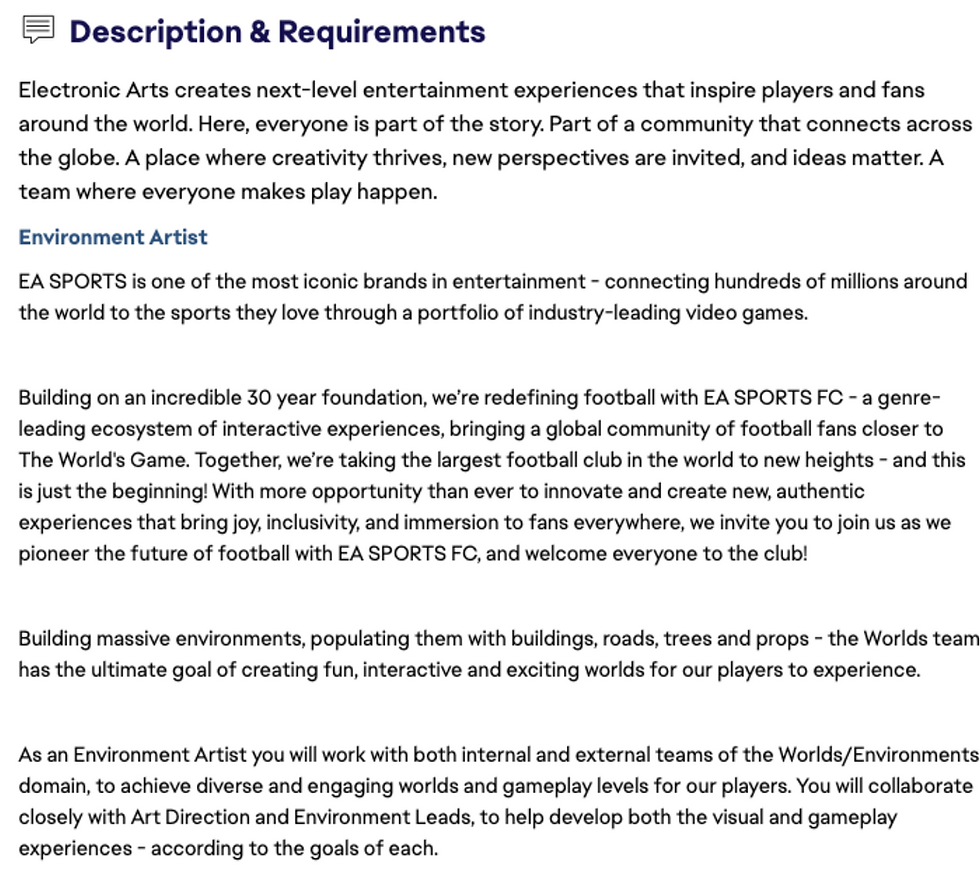
The key to a successful letter is research. Your research should inform you of why you want to work in a particular role or studio. (other than simply needing a job to pay the rent!)
Ideally, you should find an aspect of the role/studio that aligns with your interests, values and goals.
If you don't have a light bulb moment while you're reading about a company, maybe that studio or role isn't the right fit for you.
Cover Letter Structure
Structure - Contents
Simple header, with your contact information. Name, location, email address, portfolio links, and LinkedIn.
For an email cover letter, you can skip the header, but be sure to include your portfolio links, LinkedIn and email address.
Greeting
Opening Paragraph
Body Paragraph
Closing Paragraph
Sign off and signature.
Structure - Introduction
The opening paragraph of a cover letter introduces you to the reader. It's an opportunity to include a compelling "hook" that sets you apart.
This is also an ideal place to say why you're interested in the position or company before you get into your job history.
Remember - enthusiasm and genuine interest make a strong first impression.
Greetings
If you can, you should try to research the name of the recruiter. If you can't find a name, you may use:
To whom it may concern,
Dear Hiring Manager,
In the first paragraph, you should:
Introduce yourself
Briefly explain who you are
Specify the position you're applying for (and possibly where you found the job posting)
Explain why you are interested in this job posting.
For Example:
My name is Laura, and I am excited to apply for the Junior 3D Artist position at [ X Studios]. As a passionate 3D artist with a strong foundation in creating high-quality assets and environments for games, I am eager to contribute my skills to the development of the [ X project]. The mix of stylised and realistic artistic elements in [X show/project] strongly appeals to me, as it aligns with my experience and creative interests
Structure – Main Body Paragraph
Your second paragraph is the substance of a cover letter.
Here is where you present your work history, achievements, skills, and any other benefits of hiring you.
For the most part, body paragraphs give your resume context. You should tailor your writing to the company and the position.
Try to match the style and tone of the initial job posting.
Use keywords and the language from the company's job post if it mentions certain software or skill sets.
Middle Paragraph Example:
At Think Tank, I've gained hands-on experience with NukeX, focusing on 2D and 3D tracking, matte creation, keying, and colour grading. Working with my mentor, an ILM Comp Lead, I honed my ability to organise and apply her feedback effectively by maintaining a detailed Notion page. Each week, I tracked her suggestions, set goals, and gathered resources to guide the next steps for my shots. This approach ensured clear communication, steady progress, and professional-quality results. I've also developed skills in BorisFX tools like Mocha, Silhouette, and Syntheyes, as well as experimenting with Higx, a Nuke Point Render. These tools complement my NukeX knowledge and demonstrate my ability to quickly adapt to new software. My demo reel features projects like integrating live-action footage into CG environments (and vice versa), creating set extensions with projections and crowd additions, as well as exploring deep compositing techniques, and developing unique compositing effects through look development.
Middle Paragraph Example:
My academic foundation has shaped how I approach visual storytelling in VFX. During my Bachelor's in Multimedia and Mass Communication, I specialised in advertising, which taught me the importance of design and audience engagement. These lessons have become the backbone of my creative approach. When working on my palace scene, for instance, I relied on these skills to ensure the architecture and furniture felt cohesive with the historical narrative. Drawing from my experience designing magazine covers and campaign visuals, I focused on creating a deliberate interplay of textures and colours to evoke the right tone for the setting. This fusion of advertising principles with VFX workflows allows me to craft environments that not only look authentic but also carry an emotional weight that enhances the story.
Structure – Closing Paragraph
The closing should reiterate the main points and end memorably, like other conclusions.
Thanking the company for the opportunity to apply is an old-fashioned convention, but it works with formal or traditional applications. If you can, restate your enthusiasm in the closing paragraph, just to remind them.
Sign-off
Standard sign-offs include:
Regards,
Best,
Sincerely,
Closing Paragraph
Can be super simple! A couple of sentences is plenty.
Be sure to use confident language! I would avoid phrases like "I hope…" or "I believe…"
Instead, use phrases like "I look forward to…" or "I am…"
Thank the reader for their time and express interest in the next step of the recruiting process.
Closing example:
I strongly believe my contributions at Pixar Animation Studios will be beneficial for the workflow, helping artists "to go infinity and beyond" with their art. I have been waiting for an opportunity like this since I was a kid, and I will strive for my best every day. Thank you for your time and consideration.
Why, What, How?
If staring at a blank page has got you feeling more frozen than a sidewalk in Saskatchewan in January, a strategy I like - and use myself - is asking yourself Why, What, and How.
You don't have to use this framing; feel free to mix up the order in a way that works for you. I find that by addressing Why, What, and How, I get a pretty good framework for a cover letter.
Why?
Why – Why Are You Applying to This Role?
Why should a recruiter consider your application? Why do your skills set you apart? The introduction is a great place to address this question.
Here, you can elaborate on your resume to highlight any skills and achievements. However, phrase it so that it links back to the job description. This is where the list of keywords and phrases we made comes into play.
You must talk about why that company. Was it their character animation reel that stood out, or was it the company's ethos?
Try to be thoughtful. Applying to ILM and saying you're a huge Star Wars fan is nice to know, but it's not very original. Dig a little deeper and talk about the impact that had on you. Why has your love of Star Wars compelled you to apply?
What?
What - What Are You Applying For?
You'd be surprised how many people, especially multifaceted artists, don't clearly state what they are applying for.
Briefly talk about what you learned, what excites you and what it is about the role that keeps you motivated.
What have you done in your education and career to date that makes you an ideal fit?
The main body of the letter is a great place to address what skills and experience you have that make you a great fit.
What?
What – What Do You Do That Makes You Different?
Consider you are viewing 150 applications a day, and you've got a tight deadline to read, review, communicate with your team and the candidate, and organise interviews, the turnaround time is very tight indeed. A recruiting cycle typically takes 4 to 6 weeks for one candidate to be hired, and hiring cycles have gotten longer every year since 2021. (Source: Gem 2025 Recruiting Benchmarks / SHRM 2025 Recruiting Benchmarking). This does not include any speculative applications for roles they are not actively hiring for.
If you cause the recruiter any doubt, your application may not be taken further.
I have had candidates write to me with no clear indication of what role they are applying for, and like most recruiters, I didn't have time to reach out to the candidate to clarify.
Remember, the language you use will be parsed and used to populate the ATS. Using the phrases directly from the Job Description will help boost you to the top of the pile. You need to pepper the keywords in your letter to help your chances!
How?
How - How Are You A Good Fit For The Role You're Applying to?
The Closing Paragraph is a great place to answer the question of how your skills and experience align with the role you're applying for.
Here, it's important to demonstrate how your experience fits the role.
How did the skills you learned make you a better artist, team player, and more effective problem solver?
What did you learn? Why is that significant? And How can you take those skills forward into your next challenge?
If you can tackle these three questions, that should give you a solid foundation for a cover letter.
Housekeeping and best writing practices.
Layouts and Fonts
Use a clear, readable font. Such as Arial, Lato, or Calibri, etc.
Avoid fonts with serifs, such as Lucinda.
Choose a sensible font size and line spacing.
Save the cover letter as a Word doc.
Be mindful of the file name when you apply.
Consider a file name such as Name_jobtitle_coverletter.doc.
It is best to keep the letter formatting simple rather than having fancy headers/footers.


Comments