Assessing Job Postings: How to Read Between the Lines

Before you can start thinking about crafting your cover letter or resume, you need to find jobs to apply to. The most common places to look are company websites, LinkedIn, networking contacts, and online job boards. Once you've found a role that interests you, the real work begins.
Your job as a new grad or junior artist is to make it as easy as possible for the recruiter and hiring manager to understand why you are a fit for the role they're trying to fill. That starts with knowing how to read a job posting properly.
Where to Look for Jobs
It sounds obvious, but a surprising number of people limit themselves to one or two sources. Cast your net wide:
Company websites: many studios post roles on their own careers pages before anywhere else
LinkedIn: useful for both job listings and for researching the people doing the hiring
Networking: Some of the best opportunities never get posted publicly at all. Check out my article about Networking Tips and Tricks for more info
Online job boards: good for volume, but don't rely on them exclusively
Picking Up Keywords
Most people read a job description and focus only on the bullet points that describe the role. But a well-written job posting tells you far more than that if you know what to look for.
Read the whole thing, including the company blurb at the top. That language is there for a reason, and it tells you what the studio values, how they see themselves, and what kind of person they want to hire. Your job is to pick up on that language and reflect it back in your cover letter and resume.
Let's use a real example: an Environment Artist role at EA SPORTS.
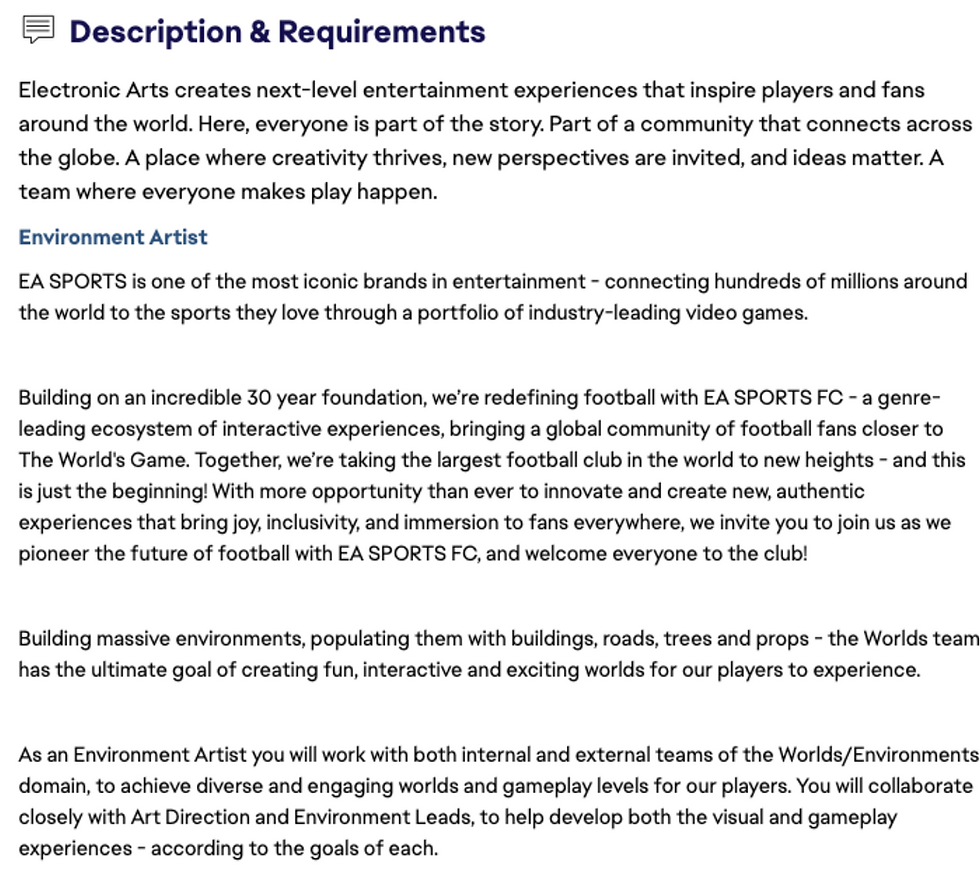
The company blurb mentions innovation, joy, inclusivity, immersion, interactive experiences, diverse and engaging worlds, and creating fun. Those aren't throwaway words. If you can genuinely speak to any of those values in your cover letter, use them.
Further down, the posting mentions buildings, roads, trees, and props. If you have experience working with any of those asset types, that's a direct connection you can draw.
The posting also references EA's 30-year legacy and the scale of the FIFA/EA SPORTS FC franchise. Recognising that history and speaking to why it matters to you is a far stronger opening than a generic "I've always loved games."
Breaking Down the Job Description
A job posting typically has a few distinct sections, and it's worth treating each one differently.
Responsibilities are the non-negotiables. These are the things you will be expected to do from day one, so read them carefully and be honest with yourself about whether you can genuinely speak to them
Requirements are where there's a bit more flexibility. Not every candidate will tick every box, and most hiring managers know that. The key is to demonstrate that you understand the scope of the role and that you're actively working towards any gaps.
The preferred or bonus section is not obligatory. If you happen to have those skills, great, mention them. If you don't, leave them out. Do not claim to have skills you don't have; you'll get found out very quickly in a small industry.
Geographical and immigration requirements are worth checking early. If you can't meet them, your application may stop before it's even read.
One more thing: if the pay range is listed, do not reference it in your cover letter or application. It's useful information for you, but it has no place in your letter.
Reading Between the Lines
Here's where it gets interesting. Keywords in a job description don't always mean exactly what they say on the surface.
Take a phrase like "strong organisational skills." What a studio actually means is: can you structure your own work, prioritise tasks, and give accurate time estimates? That's what they want to see evidenced, not the words themselves.
Here are some common phrases and what they're really asking for:
Effective, creative, problem-solving: Can you find solutions independently without needing to be walked through every step?
Methodical and solutions-based approach: Do you have a structured process, or do you just wing it and hope for the best?
Time sensitivity: Are you reliable with deadlines? Production schedules don't bend easily.
Good collaboration and teamwork: Can you work with other departments without creating friction?
Taking responsibility for your shots: Are you accountable? Do you flag problems early rather than hoping no one notices?
Thorough and thoughtful approach, going beyond the black and white of a given task: Do you take initiative, or do you do the bare minimum?
Effective communication: Can you articulate where you're at, what you need, and what you're delivering?
Once you've identified what these phrases actually mean, you can start to think about where in your own experience you've demonstrated those things, and then work that evidence into your cover letter and resume.
Technical Skills vs Soft Skills
Not all requirements carry the same weight. Some technical skills are firm requirements; others are more flexible depending on the studio and the role.
For an animation role that lists "Proficient in Maya," you can safely assume that's non-negotiable. Maya is the industry standard, and a studio isn't going to train someone from scratch on their core tool. On the other hand, experience with a more specialised piece of software, such as Blender, is often listed as a nice-to-have rather than a dealbreaker.
Soft skills are just as important, even if they're harder to quantify. Communication, interpersonal skills, leadership, problem-solving, time management, and teamwork all fall into this category. The thing to remember is that soft skills don't have to come from industry experience. Think about your transferable experience, whether that's from another job, volunteering, a team project at school, or anything else where you can point to a real example.
Start by jotting down a few phrases or even just words for each soft skill you want to address. Focus on moments where you genuinely demonstrated that skill, and build from there
It's a Fine Line
Assessing a job posting honestly sometimes means acknowledging that a role isn't the right fit yet. If you're a junior, applying to senior or supervisor-level positions isn't going to serve you well. Be realistic.
At the same time, your cover letter is not the place for self-doubt. Once you've decided a role is appropriate to apply for, your job is to make the case for why you can do it. That tension between being honest about where you are and selling yourself confidently is something most people find uncomfortable at first. That's completely normal. It gets easier the more you do it.
The goal is to read the posting thoroughly, extract the language and the intent behind it, and then connect it clearly to your own experience. Do that well, and you've already put yourself ahead of most of the applications in the pile.


Comments